A. I can't believe it's already June!
B. I can't believe we already have cucumber beetles! (again.)
It seems early to be dealing with these guys, but it turns out they are right on time and we were the ones who were late last year. The good news is that our plants are pretty well established & we already have some cucumbers, so that helps get us a small step ahead of the beetle.

Last year the beetles and the squash bugs completely demolished all of our squash and cucumbers. Seriously, we got one cucumber. And not a single zucchini! I blame myself for not identifying them sooner, but hey - live and learn...
Speaking of identifying, here's what they look like:
They're problematic not only because they chew on the leaves & fruit, but also, because they spread squash mosaic virus and transmit a bacteria that causes bacterial wilt in plants like cantaloupe, cucumbers, pumpkins, and butternut squash.
So, what do you do if you see these guys all over your plants? First, act fast! Last year, the bacterial wilt spread so quickly that we lost our cucumber plants in about 2 days. Once the plant is infected, there's no turning back the disease.
Here's what we've been doing to try to keep damage to a minimum:
B. I can't believe we already have cucumber beetles! (again.)
It seems early to be dealing with these guys, but it turns out they are right on time and we were the ones who were late last year. The good news is that our plants are pretty well established & we already have some cucumbers, so that helps get us a small step ahead of the beetle.

Last year the beetles and the squash bugs completely demolished all of our squash and cucumbers. Seriously, we got one cucumber. And not a single zucchini! I blame myself for not identifying them sooner, but hey - live and learn...
Speaking of identifying, here's what they look like:
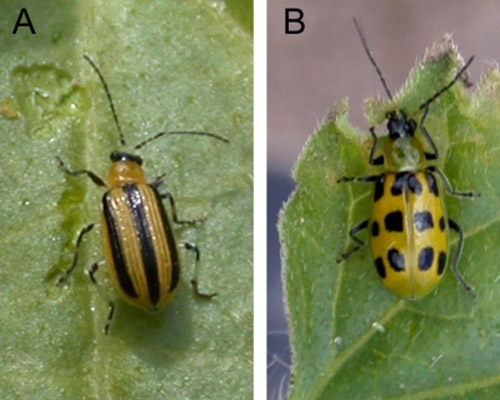 |
| photo from Illinois Fruit and Vegetable News |
They're problematic not only because they chew on the leaves & fruit, but also, because they spread squash mosaic virus and transmit a bacteria that causes bacterial wilt in plants like cantaloupe, cucumbers, pumpkins, and butternut squash.
So, what do you do if you see these guys all over your plants? First, act fast! Last year, the bacterial wilt spread so quickly that we lost our cucumber plants in about 2 days. Once the plant is infected, there's no turning back the disease.
Here's what we've been doing to try to keep damage to a minimum:
- Our first line of defense is companion planting. We surrounded the squash plants with borage and marigolds. The cukes are flanked with radishes, which may be the only reason we don't have even more beetles. This requires some planning ahead of time, but was high on our list of improvements this year.
- We also moved all the cucurbits into cedar raised beds. We knew we had to move them to another locale in the yard either way because last year's infestation in the row garden was so bad, they were sure to spring up in the same spot this year looking for more. Hopefully the cedar will help deter the insects as well.
- Plant extras. If all of our squash & cucumber plants make it, we're going to have more than we know what to do with! We expect to lose some, but we're also expecting to make some pickles.
- Beneficial bugs. Unfortunately, we didn't plan ahead enough for this one, but beneficial nematodes are recommended to help control the cucumber beetle and many other insects.
- RELEASE THE CHICKENS! As soon as we noticed these little buggers, we grabbed our juvenile hens and dropped them in the garden bed. I tried to encourage them to eat the beetles instead of the cukes, but they're young and they distract easily, and ok... not really easy to train.
- Remove & squish. This method is simple - if I see 'em, I squish 'em. But it's time consuming and not likely that I'll catch them all.
- Neem oil. When we realized there were enough to warrant concern, we decided to break out the neem - mostly because it's what we have on hand & it's a good organic solution that doesn't harm beneficial insects. In our experience, neem works best as a control method rather than an eradication method. It's generally considered one of the safest organic pest solutions, but I checked with a local hatchery just to be sure it was ok to use around the chickens (especially since I just taught them it's ok to climb around and forage in there). They assured us that it is safe & non-toxic for the girls. Another treatment they suggested was food grade diatomaceous earth, which I've read is often used with chickens to prevent/treat mites & lice, and would certainly take care of the cucumber beetles. Should we need to go the eradication route, it's an option, but for now we seem to be staying ahead of them & will hopefully have a pickling party with our own cukes in a couple months.


