Showing posts with label garden. Show all posts

Thursday, June 9, 2011

is it that time already?

A. I can't believe it's already June!
B. I can't believe we already have cucumber beetles! (again.)

It seems early to be dealing with these guys, but it turns out they are right on time and we were the ones who were late last year. The good news is that our plants are pretty well established & we already have some cucumbers, so that helps get us a small step ahead of the beetle.


Last year the beetles and the squash bugs completely demolished all of our squash and cucumbers. Seriously, we got one cucumber. And not a single zucchini! I blame myself for not identifying them sooner, but hey - live and learn...

Speaking of identifying, here's what they look like:
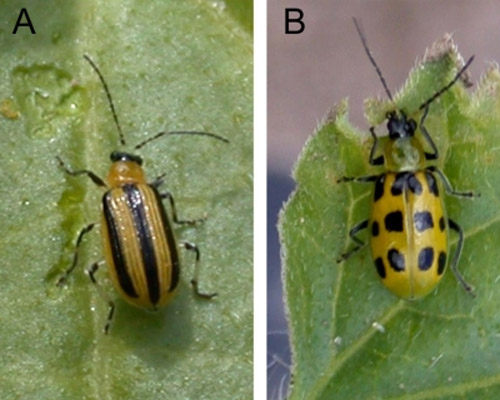
photo from Illinois Fruit and Vegetable News

They're problematic not only because they chew on the leaves & fruit, but also, because they spread squash mosaic virus and transmit a bacteria that causes bacterial wilt in plants like cantaloupe, cucumbers, pumpkins, and butternut squash.

So, what do you do if you see these guys all over your plants? First, act fast! Last year, the bacterial wilt spread so quickly that we lost our cucumber plants in about 2 days. Once the plant is infected, there's no turning back the disease.

Here's what we've been doing to try to keep damage to a minimum:
  • Our first line of defense is companion planting. We surrounded the squash plants with borage and marigolds. The cukes are flanked with radishes, which may be the only reason we don't have even more beetles. This requires some planning ahead of time, but was high on our list of improvements this year.
  • We also moved all the cucurbits into cedar raised beds. We knew we had to move them to another locale in the yard either way because last year's infestation in the row garden was so bad, they were sure to spring up in the same spot this year looking for more. Hopefully the cedar will help deter the insects as well. 
  • Plant extras. If all of our squash & cucumber plants make it, we're going to have more than we know what to do with! We expect to lose some, but we're also expecting to make some pickles.
  • Beneficial bugs. Unfortunately, we didn't plan ahead enough for this one, but beneficial nematodes are recommended to help control the cucumber beetle and many other insects.
  • RELEASE THE CHICKENS! As soon as we noticed these little buggers, we grabbed our juvenile hens and dropped them in the garden bed. I tried to encourage them to eat the beetles instead of the cukes, but they're young and they distract easily, and ok... not really easy to train.
  • Remove & squish. This method is simple - if I see 'em, I squish 'em. But it's time consuming and not likely that I'll catch them all.
  • Neem oil. When we realized there were enough to warrant concern, we decided to break out the neem - mostly because it's what we have on hand & it's a good organic solution that doesn't harm beneficial insects. In our experience, neem works best as a control method rather than an eradication method. It's generally considered one of the safest organic pest solutions, but I checked with a local hatchery just to be sure it was ok to use around the chickens (especially since I just taught them it's ok to climb around and forage in there). They assured us that it is safe & non-toxic for the girls. Another treatment they suggested was food grade diatomaceous earth, which I've read is often used with chickens to prevent/treat mites & lice, and would certainly take care of the cucumber beetles. Should we need to go the eradication route, it's an option, but for now we seem to be staying ahead of them & will hopefully have a pickling party with our own cukes in a couple months. 

Monday, May 30, 2011

garden of greens

It's the end of May and our greens garden is flourishing! Last year, this was our only planting area and we had quite a few things here that didn't really have enough time to take off, or receive enough sun once they did. This year, we got ourselves in gear and started early with seed sprouting in the basement in February. This part of the yard gets a bit too much shade for veggies like tomatoes, eggplant, & peppers. It will work, but it will definitely take more time for everything to ripen. Since we have a new raised bed area in a very sunny spot this year, we decided to dedicate this space primarily to greens & early spring veggies and have most of the fruiting plants in the raised beds. 

By late March/early April our seedlings were hardened off & we were filling the space with brussels sprouts, broccoli, cauliflower, lettuce mixes, several kale, chard, & spinach varieties, onions, purslane, beets, herbs, and peas. The planning is finally paying off and my dream of having enough kale in the garden to make kale chips every day is finally being realized! :)

The kale in the back had overwintered & is bolting now, but the flowers are edible and very tasty!
Another lesson learned - we added straw between the rows, which we loved! Until we realized we should probably only add straw that hasn't gone to seed - as you can see, we grew a lot of grass. :) We've just replaced this with a weed tarp & some very nice cedar mulch.
Onions planted in late April.
Delicious summer lettuce mix. We've been able to harvest all our salads for a couple of weeks now & hope to keep it going through at least mid-summer.
Parsley & Purslane (p.s. if you haven't had it, purslane is delicious & has more omega 3 than any other leafy plant! we could never find it anywhere, so we decided to grow it ourselves)
Cauliflower is coming along well.
Spinach, lettuces mixes, and kale harvested earlier this week.

Monday, February 21, 2011

doing it wrong

One of our primary reasons for taking the time to document what we are doing with the garden is to learn from our own mistakes & to share the experience as we go. In looking back at last year, there were lots of things that could have been done better and would have likely given us a more successful garden, but at the same time, one of the most beautiful things about gardening is that it's pretty hard to really mess it up. Sure, you can plant your seeds too deep, you may not have the perfect soil or the perfect light, or you may not recognize a destructive bug in time to save a plant (we have been guilty of all of the above! :)... but in the end, nature finds a way to create something amazing, despite everything you've "done wrong", and you learn how to improve it next time. It becomes less a case of "good vs. bad" ideas and more a case of "better, and even better than that".

2010 Garden space - Dug & fenced in April/May, so we were a bit late for transplanting

Basil & Tomatoes - 2010 Garden


Lessons Learned
(I am a project manager, remember... ;)

  • Research, research, research!
    Last year, we jumped in eagerly without much research or a clear plan of everything we would plant, when we should start them, & where they might grow best. We both had gardens before, but not quite on this scale or with the goal of significantly increasing how much of our overall food consumption comes from our own yard. This year, we are planning out what we're growing in a super-duper spreadsheet that would make any project manager beam with organizational joy. Including ideal & actual seed-starting and transplant dates, companion plants & those to avoid, specific info on each variety, and anything else we wanted to see at a glance. Yes, it's even color-coded. *swoon*
    Ours is probably overkill for most, but there are some great online resources for this:
    Skippy's Vegetable Garden calendar: http://bioarray.us/Skippy's%20planting%20calendar.html
    You Grow Girl's seed chart:
    http://www.yougrowgirl.com/2006/03/31/the-lazy-gardeners-seed-starting-chart/
    Johnny's seed calculator: http://www.johnnyseeds.com/e-PDGSeedStart.aspx
  • Map it out
    It's hard to believe that little tomato start will be 8ft tall, or that the zucchini (assuming it avoids the plague of squash bugs) can become a jungle of vines that creates too much shade for another plant. But, it happens... and faster than expected. We are using online planning software to map things out a bit this year & hopefully that will help. We are planning to use this one: http://www.growveg.com/gardenplanner/gardenplanner.html
  • Give them a good start
    After lots of research, tips from fellow bloggers, and many hours of YouTube videos, we decided to try building our own seed-starting station with a standard 5 tier wire shelf from Lowe's, shop lights, & fluorescent bulbs. We also opted to make our own soil mix and try using soil cubes this year. We're very excited about this project and it's been really fun so far! Photos & details to follow soon!
  • Relax and enjoy the process
    Ok, I will admit this can be a challenge for me, especially in the planning stages! :) I find myself getting anxious about the timeline (again, curse of the project manager) and wanting to jump to the next task before we finish the one we're on. I actively remind myself not to rush and to learn to live with imperfections (wabi-sabi, baby!). At the end of the day, all the planning in the world isn't going to stop a frost or a very determined group of cucumber beetles. Perhaps the biggest lesson I've learned from gardening is that I am definitely not in control. But, as I watch seeds sprout from tiny little pods, or how a certain plant attracts a very specific insect for pollination, I'm grateful for the reminder to let go and simply enjoy being a part of this interconnected process.

Saturday, February 12, 2011

garden v2.0

Our first seed order of the season arrived and we are so excited to get going for Spring! Our entire backyard still looks like a frozen tundra, but we are busy indoors mapping out all of our new plans for garden expansion and chicken residence. We have also both come to the conclusion of "who needs a yard?" ... ok, it was actually more like, "f*** the yard. what's it doing for us??" We made the decision that I think a lot of people have - that we, and the environment, would be better served by landscaping most of the yard with edible & native plants - plus no one really wants to mow. ;) It's not going to be a one-season job, but at least we have an evolving plan to inspire us now!


Our first seed order is from Johnny's Seeds and we're anxious to try them for the first time. Most of them are vegetables that we picked up at the Farmer's Market last summer and loved.
  • Borage - This one was recommended as a companion plant for the tomatoes and squash, but is also a great attractor of pollinators. After last year, we need all the help we can get with controlling squash bugs. Please feel free to send any suggestions! Bonus: the flowers are edible! Hello, pretty salads. :)
  • Cippolini Gold Coin Onions - I tried these for the first time last summer in a canning class and loved them. This will be our first attempt at onions, so we'll see how that goes.
  • Romanian Sweet Peppers
  • Yard Long Red Noodle Beans - another market find last year. These are great in stir fry!
  • Carmen Peppers - I have Deep Mudd Farm to thank for my addiction to these. Yum.
  • Sun Gold Tomatoes - another highly addictive market find. These brought us back every week and we ate them like candy. Best cherry tomato I've ever had!

Speaking of seeds, if you are in the St. Louis area, there is a fun seed swap event coming up with Drop.Swap.Grow! I will be traveling that day, but the awesome boyfriend will be there with seeds for swapping.

Monday, October 11, 2010

basil, basil, basil!

By far, the most overwhelmingly successful thing we grew this summer was the genovese basil. Started from seed, we ended up with 4 huge plants over 3' tall and about 2-3' around. I've been using as much as I can throughout the season - caprese salads, fresh basil in tomato sauces, with fish, with my eggplant, & in scrambled eggs with feta (yum) & giving it away in handfuls.

Recently, it's started to get a bit chilly around here - even close to freezing one night last week, so I'm scrambling to cut the basil while I can and find ways to use it! Some of it has already developed some black spots from getting too cold. But it does make a beautiful bouquet. :)


It also makes for some delicious and easy recipes - perfect for a beginner cook like me. First, I tried a new basil marinade (recipe here) and, wow, it is delicious. I used about half of the bunch pictured above & it made about 3 cups, so I froze two in Ball Freezer Containers. What I didn't freeze was used tonight on some chicken and cauliflower, which the boyfriend devoured while raving about the marinade! It's also quite good as a simple salad dressing. Plus it's a beautiful shade of alien goo green. Definitely a keeper for the recipe file.

The rest of the cuttings went to a simple, but delicious pesto, which also went into the freezer and, along with the previous batch, should last us several months.

There's still a bunch of basil out there because I knew I couldn't use it all last weekend and, frankly, I'm still having a hard time admitting it's season is over. :P Maybe I'll get bold and try to go all Top Chef with a basil ice cream! (though I wouldn't have any idea if it tasted as it should, it sounds like a delicious experiment) Or maybe I'll be lazy and it will go into the dehydrator. ;D

Monday, September 27, 2010

fall, already and officially

I keep referring to our "fall garden" yet I'm having a hard time admitting the season has come. Even now when the weather is forcing me to wear tights and leggings with my summer dresses. Fall has actually been my favorite season for as long as I can remember - the crispness of the air, the cooler weather, and the promise of being able to pull my favorite boots out of the closet. This year I don't want summer to end because there's so much fall work to be done for us to get ready for next spring!

Fall does have it's perks for gardening though - we finally harvested enough lettuce for salads last week! The spinach, chard, and kale are all filling in nicely as well.


I'm in Seattle this week, so that's making the seasonal transition a bit more convincing. Beautiful clear skies the first day, but now it's rainy and cold enough that I'm wishing I'd packed my fingerless gloves. It's a shame I couldn't fit the boots in the suitcase too.

I did manage to get away from scheduled activities long enough to visit the famous Pike Place Market, though, which was a real treat.


I finally found an organic garlic braid to hang in the kitchen and use all winter as well. I'm thinking about going back for the peppers too. The small garlic braid was only $10 and is all wrapped up in newspaper to take home. :)


Hopefully, I can make it back down there again before the end of the trip.

Wednesday, September 15, 2010

praying for a mantis.


Look who I found hanging out on the hummingbird feeder! The elusive praying mantis. Some say they are a gardener's dream for managing other plant pests. Plus, I'm one of those weirdos who think they are super cute with their little alien eyes and rotating heads. Apparently, the hummingbird feeder was leaking and the sugar water was attracting every ant for miles... enter the praying mantis for the all-you-can-eat ant buffet! :)

I brought him out to the garden with me and he climbed off the feeder somewhere around the mint and cucumbers. Though he'll have to work a tiny bit harder for his meals, I'm pretty sure he'll have enough food over there. Hopefully he will stay and help out with the remaining cucumber beetles and assassin bugs. Maybe "he" is even a "she" and more little mantises will start popping up.


Beneficial or harmful for the garden? It's true that the praying mantis does not discriminate. He'll eat a cucumber beetle or a beneficial lacewing, both are quite tasty for him. However, with a severe lack of beneficial bugs in the garden and an overgrowth of destructive ones, I'm happy to take my chances. Welcome home, Mr. (or Ms.) Mantis.

Saturday, September 11, 2010

from the garden: today's tomatoes

today's tomato harvest, plus one chili

Welcome September, the month of tomatoes? We finally have tons of green and recently red tomatoes popping up all over the garden. With 8 cherry tomato plants, about 6 brandywine, and 3 unidentified tomato plant gifts, we should be well-stocked for a while so long as the weather doesn't get too cold or wet.

One of the cherry tomato plants has been the star of the garden and has been producing tomatoes consistently for about a month, but never more than a few at a time. Today, I think I pulled 3x that amount from him and quite a few from his neighbors as well. The only productive brandywine (so far) is still all green, but there are about a dozen more fruits starting while we wait for the good-sized ones to ripen. The "gifted" tomato plants have been the most productive, but I admittedly question their fertilizing methods before arriving in our yard. For that reason, they're sequestered to their own area ;) but still far more edible than what I tend to find in a supermarket.

Saturday, August 28, 2010

cute things keep eating our food

Ok, not-so-cute things too.

But, let's start with the bunnies. They're not so much of an issue now that we have a secure fence, but before we got that together, they had a daily feast. Bunnies have munched our kale, lettuce, blueberries, grapes, raspberries, and blackberries. Don't get me wrong, I love the bunnies. I even have a holland lop bunny named Alonso residing in my home... and he eats a lot of organic produce too, come to think of it. Thankfully, the fencing has eliminated any sort of internal struggle I might have in the battle of bunny vs. sustenance. Hopefully, we can now have some of those 'spring greens' in fall.

this one was so cute, i actually *tried* to feed him.

The terror of the garden now is the cucumber beetle & his friend, the squash bug. Their first victim was the lone cucumber plant. We'd just harvested our first cucumber, and several more were in progress, when I started noticing wilted leaves. After some research, I identified the "yellow ladybug" and tried to save the plant, but to no avail. I'm still not sure exactly what happened, but it looked like bacterial wilt.

we have the striped & the spotted ones. we're lucky that way.
The squash bugs showed up shortly after. I noticed an insect laying eggs on the squash and watched in awe. Mistakenly thinking this could be a beneficial bug, I let them flourish and take over the garden. I thought they might take out the cucumber beetles. I'm a n00b, I know. Since correctly identifying them as the destroyer of squash (where's Gil Grissom when you need him???), I've started regularly dousing them with an organic garlic spray concoction. They don't like it, but it hasn't quite gotten rid of them either. The fate of the squash is yet to be determined.

squash bug laying eggs on our summer squash plant.
With organic gardening, there are some sprays & repellants that can be used, most of which you can make yourself - essential oil sprays like garlic, peppermint, etc., soap-based sprays, baking soda, and several others. However, as with most things in life, it seems the best way to control pests like beetles is to prevent them. (Now we know what to do next year. :) While we have used some essential oil sprays and soap sprays, we'd ideally like to support a symbiotic ecosystem in the garden with beneficial bugs eating destructive bugs, and not rely on sprays at all.

We hoped to have some praying mantids in the garden, but we were late to the beneficial bug party this year, so it's at the top of the list for next spring. We did, however, order some ladybugs from amazon.com (further proof you can get anything at amazon.com). They arrived in great shape and with clear instructions on how to release them. Having no experience with keeping bugs instead of getting rid of them, I was surprised to find that you should store them in the refrigerator until release. Though I was concerned they'd die in there next to the soy milk, it actually helped to make them less alert and slow-moving for release. Once you take them out of the fridge, it takes a few minutes for them to become active again, so it's a good time to open the lid and put them in the garden without having them all rush the top at once.

The ladybugs stayed around for a few days, but within a week they'd all left. We did multiple releases over the course of a couple of weeks, but I'm guessing there just wasn't enough of the food they prefer to stick around. Still, a small investment to at least give it a try.

The most recent visitor to wreak havoc was actually enjoyable to watch, which is always a plus. These are black swallowtail caterpillars and grow up to be very beautiful butterflies.

fat swallowtail caterpillars in the parsley
what the caterpillars become

Granted, they devoured every last bit of the parsley in the span of a day, but they were so stunning to watch, I must admit that I really didn't mind. Maybe in their next life they'll return the favor by coming back to pollinate.

Tuesday, August 17, 2010

fall planting

The spring/summer plants finally seem to be getting into full swing. With the late start, it seems like we've been waiting quite a while. Finally, we have summer squash coming in pretty regularly, our first patty pan squash has started, we'll soon be swimming in cherry tomatoes, peppers are getting productive, and the eggplant is starting to blossom.

To keep the momentum going, and to take advantage of all the stuff we missed in spring, I planted a bunch of new stuff this weekend that we're hoping will be good for Fall. This is my first time planting for Fall, but I found a couple of good planning & planting guides to help decide what to try -


Seeds for fall from seedsofchange.com
Our Fall Garden:
• kale
• beets
• spinach
• mild lettuce mix
• all lettuce mix
• bush beans
• snow peas
• sugar snap peas
• cucumbers

There's always more that we want to add (maybe garlic? possibly pumpkin?) but we'll wait at least a week or two to see what starts sprouting.


Tuesday, August 10, 2010

we must cultivate our garden.

I have a tendency to not start something until I have all the tools & materials needed to "really start" - which, I’ve recently realized, causes some things to never start. So, rather than waiting for the perfect design or the perfect post, I’m just going to jump head first into this shiny new blog. :)

There are so many new projects going on around here that I decided I wanted a dedicated place for them just so I can keep track! All of the projects pretty much start with, or revolve around, the garden. I’ve had a garden in my current yard before, but never a really hard-working one.


This year, I’ve got a partner in the projects and, with his help, we've managed to expand the garden space, put up a secure fence, and start growing quite a bit of vegetables & herbs from seed. I discovered very quickly after starting that if we take notes on all the discoveries we make now, we'll be able to make lots of improvements in the next year. (even if the summer is already almost over!)

For us, the decision to start organic gardening was an obvious one. There’s a huge yard out there that was nothing but grass, for the most part. We have been buying organic produce for years, but with the standards and regulations becoming more & more lax on organics and the food miles incurred to get a lot of this stuff to our local grocery, we thought we'd try our hand at replacing at least a small portion of that with our own food from the backyard.


We got off to a late start due to all of the initial setup to be done with seed sprouting, tilling, fencing, etc. By the time we got our plants outside, they were way past ready! We planted them anyway and hoped some would make it. So far, the squash varieties and tomatoes are doing the best, along with the hip-high basil. Turns out we were too late with the lettuces and lost the kale to baby bunnies squeezing through the fence openings. We added some chicken wire around the first fence so not even the tiniest bunny fits. We've already learned so much from the process. Plans have already started for next year and include a greenhouse this fall and raised beds for more planting!